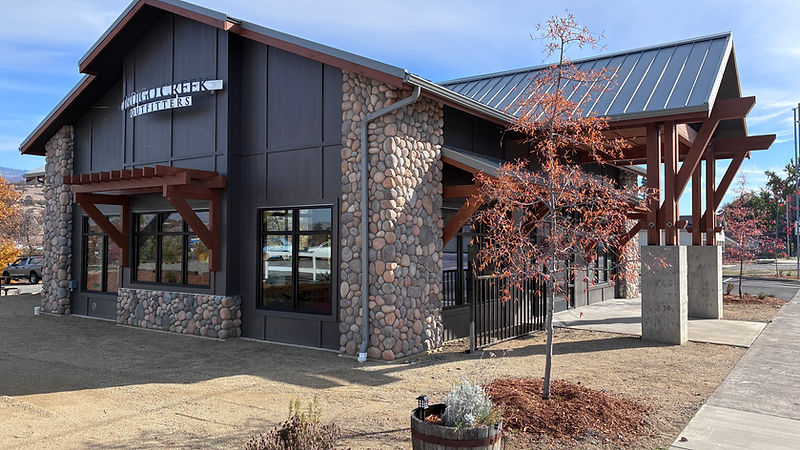
The corner of 117 South Main Street, Phoenix, Oregon

A Place with a Story

Property History

Long before The Confluence became a place for people to gather, celebrate, and connect, this piece of Southern Oregon was part of a much larger story of exploration, settlement, commerce, and community.

The history of 117 South Main Street reaches back to the earliest days of Phoenix, when travelers crossed the Rogue Valley, a small settlement known as Gasburg began to take shape, and the Furry family established a hotel that would become part of the fabric of downtown life.

Today, The Confluence carries that tradition forward. While the property and its purpose have evolved, the idea of bringing people together has remained remarkably consistent.

The long version

Five Chapters

01

The earliest days

Before Phoenix: The Applegate Trail

Long before the streets of Phoenix were established, the Rogue Valley was home to Indigenous peoples, including the Takelma, Shasta, and Athapascan peoples, whose communities, traditions, and relationships with this landscape reach back thousands of years.

In 1846, the Applegate Trail was established as a southern alternative to the Oregon Trail. The route crossed the rugged landscapes of present-day southern Oregon, bringing emigrants through the Rogue Valley on their way north toward the Willamette Valley. Although it was never as heavily traveled as the main Oregon Trail, it played an important role in opening southwestern Oregon to increased migration and settlement during the 1850s.

The arrival of settlers and prospectors brought profound changes to the region, including conflict, displacement, and the eventual forced removal of Indigenous communities from their ancestral homelands.

The trails that crossed this region helped shape the communities that followed, setting the stage for the establishment of Phoenix and its neighbors.

02

The settlement

Gasburg: The Beginning of Phoenix

The story of modern Phoenix begins around 1851, when brothers Samuel and Hiram Colver brought their families to the Bear Creek Valley and established Donation Land Claims.

In 1854, Samuel Colver laid out the original townsite on his land. The growing settlement initially became known locally as Gasburg, a name attributed to a talkative kitchen employee who served the workers at the local mills.

As the community developed, flour mills, businesses, homes, and gathering places began to establish a small but growing commercial center. The settlement eventually received the name Phoenix, reportedly chosen by mill owner Sylvester M. Wait, who was an agent for the Phoenix Insurance Company of Hartford, Connecticut. The name was officially adopted for the local post office in 1857.

What began as a small pioneer settlement along Bear Creek was becoming an established community.

03

The gathering place

The Furry Hotel: A Downtown Gathering Place

By the early 1900s, Phoenix had grown beyond its pioneer beginnings. Its downtown businesses served farmers, merchants, travelers, and the growing population of the surrounding valley.

Among the families who helped shape the community were the Furrys. Frederic E. Furry and his wife, Mary Isabelle Caton Furry, moved to Phoenix in 1909. According to family recollections documented in historical records, Mary began preparing meals for the men working on a road through Phoenix. That simple undertaking grew into the second Hotel Furry.

The hotel became a gathering place for travelers, workers, and local residents. The family also operated a busy stable nearby, serving a time when horses and wagons were still an important part of everyday transportation.

Frederic Furry operated the hotel until his death in 1931. His widow retained ownership until her death in 1947, when the property was eventually sold.

The Furry Hotel is an especially meaningful part of this property’s history. A 1979 historical nomination document identifies the former hotel as the same building then occupied by the Kachina Lounge at 117 South Main Street.

In other words, the building that is now home to The Confluence has a documented connection to one of Phoenix’s historic downtown gathering places.

04

The community

A Community That Continues to Evolve

Over the decades, Phoenix continued to change. Agriculture, transportation, local businesses, and the people who called the community home all helped shape its identity.

Like many Southern Oregon communities, Phoenix experienced tremendous change during the twentieth century. Its agricultural roots evolved, its downtown adapted, and new generations of families and businesses continued to make the town their own.

Then, in September 2020, the Almeda Fire devastated large portions of Phoenix and neighboring Talent. Homes, businesses, and familiar community landmarks were lost. The fire marked an extraordinary turning point in the town’s history.

But Phoenix is a community defined not only by what it has endured, but by how its people have come together to rebuild. New businesses, new buildings, and new opportunities have become part of the community’s continuing story.

The Confluence is proud to be part of that next chapter.

05

The next chapter

The Confluence at Indigo Creek

Today, 117 South Main Street is entering another chapter in its long history as a place for people to come together.

With roots in Indigo Creek Outfitters, a locally owned Southern Oregon outdoor recreation company, The Confluence brings a new purpose to a property with a meaningful connection to Phoenix’s past.

The name itself reflects an idea that has always been part of this place: different paths, people, and stories coming together.

Whether it’s a wedding celebration, a family gathering, a business meeting, or a community event, The Confluence continues a tradition of welcoming people through its doors.